
Simulation-Based Medical Education: How It Can Improve Patient Outcomes
Simulation-Based Medical Education: How It Can Improve Patient Outcomes
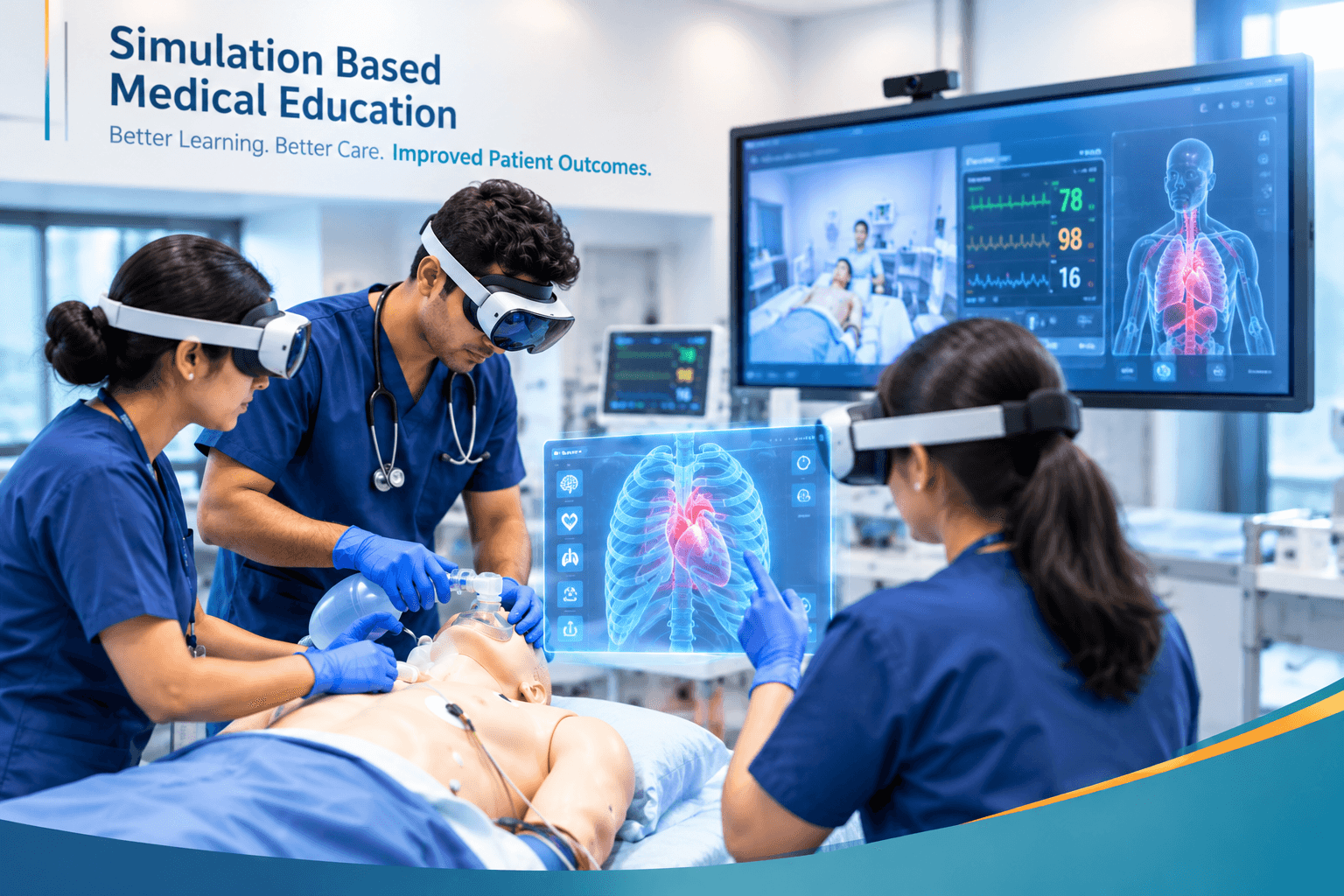
Medical education has traditionally relied on classroom instruction, observation, and supervised patient encounters to develop clinical competence. The Objective Structured Practical Examination (OSPE) and the Objective Structured Clinical Examination (OSCE) have long been central pillars of medical education, designed to assess students' practical and clinical skills systematically. While these approaches remain fundamental, growing concerns regarding patient safety, healthcare quality, and the increasing complexity of medical practice have prompted educators to explore safer and more effective methods of training healthcare professionals. Simulation-Based Medical Education (SBME) has emerged as one of the most significant innovations in healthcare training, enabling learners to develop clinical skills, decision-making abilities, communication competencies, and teamwork capabilities within a controlled environment before applying them in real clinical settings.
What Is Simulation-Based Education?
Simulation-based education is defined as an artificial representation of real-world clinical processes designed to achieve educational goals through experiential learning. Rather than relying solely on the traditional apprenticeship model of "see one, do one, teach one," simulation allows learners to engage in deliberate practice, receive structured feedback, and repeat procedures until competence is achieved. This approach is particularly important because modern healthcare systems increasingly recognise that patient safety should not be compromised during the learning process.
One of the most important contributions of SBME to patient outcomes is the opportunity that it provides for repeated practice without risking patient harm. Clinical procedures such as airway management, resuscitation, intravenous access, surgical techniques, and emergency response can be rehearsed multiple times using simulators before being performed on real patients. Simulation enables learners to acquire psychomotor skills, improve technical proficiency, and build confidence in a safe learning environment. A large meta-analysis found that technology-enhanced simulation is associated with large improvements in knowledge, skills, and behaviours compared with no intervention, and moderate improvements in patient-related outcomes. A systematic review focused specifically on patient outcomes similarly found benefits, although most of the studies were small and of variable quality. By allowing healthcare professionals to perform complex procedures repeatedly, simulation can reduce the likelihood of technical errors and enhance preparedness for similar situations in clinical practice.
Advantages of Simulation-Based Medical Education
In healthcare settings, errors frequently occur not because clinicians lack theoretical knowledge, but because they encounter unfamiliar situations, communication breakdowns, or high-pressure environments without proper training. Simulation recreates realistic clinical scenarios that challenge learners to assess patient conditions, make decisions, prioritize interventions, and respond appropriately to evolving circumstances. This develops critical thinking, clinical reasoning, and situational awareness that are essential for safe patient care. The ability to make mistakes, reflect on performance, and learn from those experiences without adverse consequences to patients represents one of the most valuable aspects of simulation-based learning.
Patient outcomes are also strongly influenced by communication and teamwork. Modern healthcare delivery depends on coordinated efforts among physicians, nurses, technicians, and other healthcare professionals. Communication failures remain a major contributor to preventable medical errors. Simulation-based training provides opportunities for multidisciplinary teams to practice working together in realistic clinical environments, strengthening collaboration, leadership, delegation, and conflict management skills. Structured debriefing sessions following simulation exercises enable participants to reflect on their performance, identify gaps in communication, and develop strategies for improvement. These non-technical skills are often difficult to teach through lectures and bedside observation alone, and are not always well captured by checklist-based OSPE and OSCE stations, yet they have a direct impact on patient safety and healthcare quality.
Technology and Adaptability
Another important advantage of SBME is its adaptability to technological innovation. Simulation has evolved significantly from simple task trainers and mannequins to sophisticated high-fidelity simulators, standardized patients, virtual reality environments, and hybrid simulation models. Augmented reality (AR) and virtual reality (VR) are shifting learning from passive, textbook-based memorization to interactive, hands-on experience: VR immerses students entirely in a digital world, while AR overlays 3D models and data onto their physical environment. These advancements allow learners to engage with increasingly realistic clinical scenarios while providing educators with opportunities to assess performance objectively and provide targeted feedback. Recent developments in virtual simulation and digital learning environments further demonstrate the growing role of technology in expanding access to high-quality medical education.
Simulation and System-Level Safety
Beyond individual skill development, simulation contributes to broader healthcare system improvement. Healthcare organisations increasingly use simulation to evaluate clinical protocols, test emergency preparedness plans, identify latent safety threats, and strengthen organisational readiness. By revealing weaknesses in workflows, communication pathways, or resource allocation before real crises occur, simulation supports safer and more efficient healthcare delivery. It also promotes a culture of continuous learning and quality improvement, enabling healthcare professionals to maintain competence as medical technologies and clinical practices continue to evolve.
Limitations and Challenges
Simulation is not a guaranteed route to better outcomes. Realistic equipment and trained faculty are expensive, and the evidence is stronger for skills in the simulation laboratory than for lasting changes in patient outcomes. Skills learnt in simulation may not transfer to the bedside without reinforcement, and more realism is not always better: highly realistic scenarios can overload novice learners and reduce learning. Simulation therefore works best when scenarios are matched to the learner's level and to clear learning objectives, and when faculty are trained to run them and to conduct structured debriefing.
Key Takeaways
• Simulation allows deliberate practice and error without patient harm.
• Evidence shows clear gains in skills and behaviours, and encouraging but less certain gains in patient outcomes.
• Benefits depend on good scenario design, faculty training, and structured debriefing.
Conclusion
Simulation-Based Medical Education represents a shift from learning through exposure alone to learning through deliberate practice, reflection, and continuous improvement. As SBME becomes more accessible across institutions, the evidence consistently shows that simulation improves skills and is associated with better patient-related outcomes, although high-quality outcome data remain limited. The question is therefore less whether simulation helps and more how systematically it is integrated into training pathways and organisational learning cultures. Healthcare institutions that treat simulation as infrastructure rather than innovation will be better positioned to build a sustainable healthcare workforce that learns as relentlessly as medicine itself evolves. As simulation technologies continue to advance and become more widely integrated into medical curricula, they have the potential to further ensure that future healthcare professionals are better prepared to deliver safe, effective, and patient-centred care.
QUICK LINKS

© Chakra 2026 | All Rights Reserved.